
Dental Implants vs Dentures: Which Is Right for You?
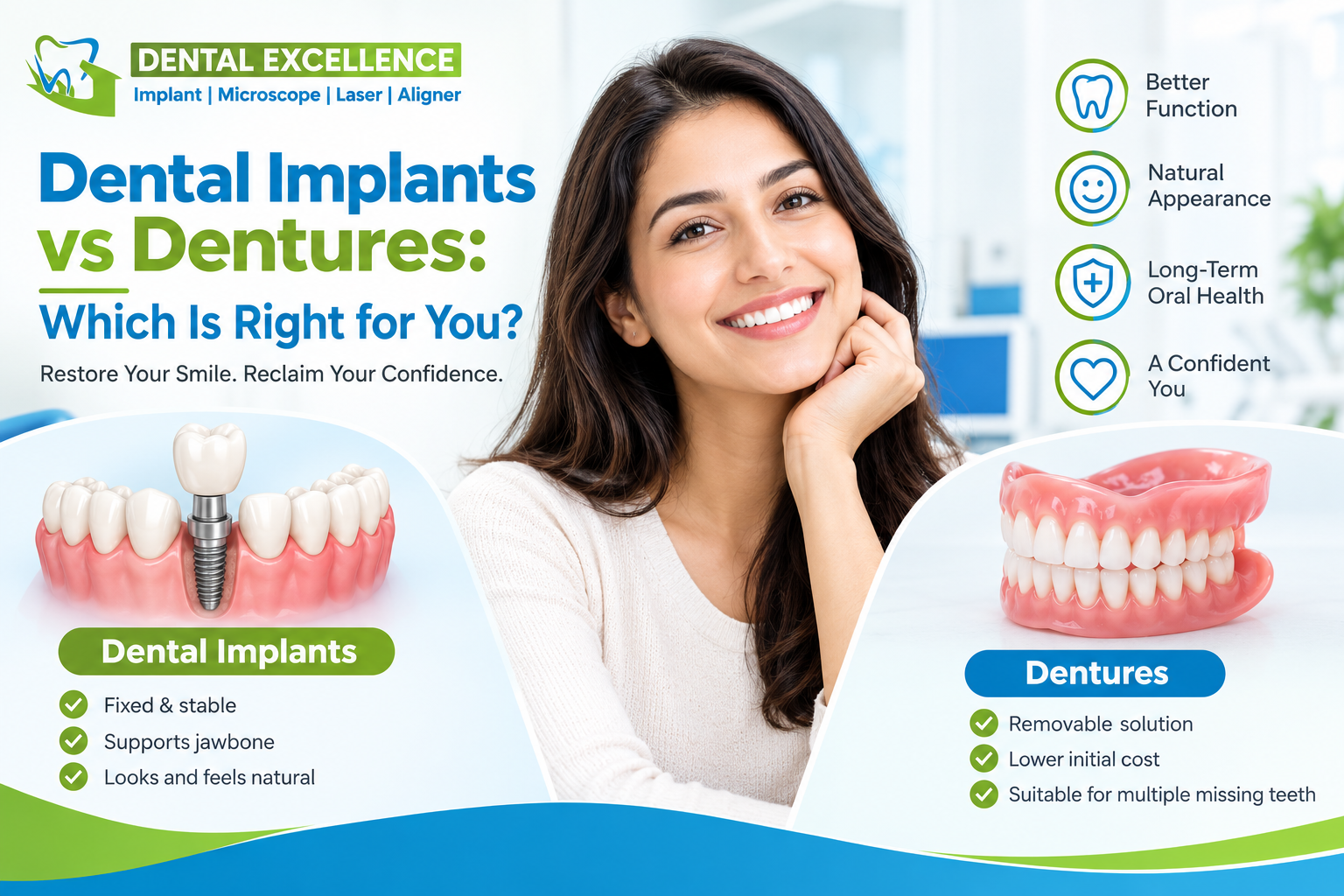
Dental implants and dentures are two common options for replacing missing teeth. They differ in how they are supported, maintained, treatment time and cost. The right choice depends on oral health, jawbone condition, the number of missing teeth, medical history, preferences and budget.
In this guide, Dental Excellence Hyderabad explains the key differences, benefits, limitations and questions to discuss with your dentist before choosing a treatment.
Quick Answer: Are Dental Implants Better Than Dentures?
Dental implants may suit people looking for a fixed tooth replacement who have suitable oral and general health. Conventional dentures may suit people who prefer a removable option, need to replace several or all teeth, or want to avoid implant surgery. Neither option is best for everyone; a dental examination is needed to determine what is appropriate.
What Are Dental Implants?
Dental implants are tooth-replacement devices designed to support artificial teeth. A small post, commonly made from titanium or another biocompatible material, is placed in the jawbone during surgery. After healing and assessment, a crown, bridge or denture can be attached to the implant or implants.
Benefits of Dental Implants
- Fixed support: An implant-supported crown or bridge stays in place during everyday activities.
- Chewing stability: Implants can provide stable support for replacement teeth when treatment is successful.
- Bone support: An integrated implant transmits functional forces to surrounding bone and may help reduce bone loss in the treated area.
- Natural-looking restoration: The replacement tooth can be designed to complement surrounding teeth.
- No daily removal: Fixed restorations remain in place, but require careful brushing, cleaning around the implant and professional reviews.
Limitations of Dental Implants
- They generally have a higher initial cost than conventional removable dentures.
- Placement requires surgery and carries risks, including infection, failure to integrate with bone and injury to nearby structures.
- Treatment can take several months depending on healing and additional procedures.
- Some patients may need gum treatment or bone grafting before placement.
- Implants require ongoing oral hygiene and professional maintenance.
What Are Dentures?
Dentures are removable dental appliances used to replace missing teeth. Complete dentures replace all teeth in the upper jaw, lower jaw or both. Partial dentures replace some missing teeth when other natural teeth remain. They are custom-made and may use acrylic resin, metal frameworks or other dental materials.
Benefits of Dentures
- Usually no implant surgery: Conventional removable dentures generally do not require implant placement.
- Lower initial cost in many cases: The price depends on materials, design and the number of teeth replaced.
- Can replace many teeth: Complete and partial dentures address different patterns of tooth loss.
- Removable for cleaning: The appliance can be cleaned separately, while the mouth and any remaining teeth also need care.
- May suit many patients: Suitability depends on oral tissues, comfort, health and individual needs.
Limitations of Dentures
- Some dentures may move while eating or speaking, particularly if fit or retention is poor.
- Patients may need time to adapt to speaking and chewing with a new appliance.
- Dentures need daily cleaning and proper storage.
- Changes in the gums and jawbone can affect fit over time, requiring adjustments, relining or replacement.
- Poorly fitting dentures can cause sore spots or irritation.
- Chewing efficiency may be lower than with well-functioning fixed implant restorations for some patients.
Dental Implants vs Dentures: Key Differences
| Feature | Dental implants | Conventional removable dentures |
|---|---|---|
| Support | Implants in the jawbone support a crown, bridge or denture | A removable appliance rests on oral tissues and may use remaining teeth for support |
| Surgery | Required for implant placement | Usually not required |
| Stability | Fixed restorations are generally stable | Depends on fit, design and retention |
| Initial cost | Generally higher | Often lower |
| Treatment time | May take several months due to healing | Often shorter, although several appointments may be needed |
| Cleaning | Brush and clean around the restoration daily | Remove and clean the appliance as instructed; clean the mouth too |
| Jawbone | May help maintain bone around the implant | Does not provide the same direct bone stimulation as an implant |
| Maintenance | Regular reviews and daily oral hygiene | Regular reviews, cleaning and possible relining or replacement |
Note: Implant-supported dentures are a separate option. Depending on their design, they may be removable by the patient or fixed in place. Their suitability and maintenance requirements differ from conventional dentures.
Are Dentures Cheaper Than Dental Implants?
Conventional removable dentures generally cost less initially because they do not involve implant surgery. Implant treatment may include examination, imaging, implant placement, a crown or other restoration, and sometimes additional procedures. Long-term costs vary: dentures may need adjustments, relining, repairs or replacement, while implants also require maintenance and occasional restoration repairs.
Ask your dentist for an itemised estimate covering consultation and imaging, extractions or bone grafting if needed, the implant or denture, restoration, follow-up visits and possible additional costs. There is no single price for every patient; an assessment is needed for an accurate estimate in Hyderabad.
Which Is Better for One Missing Tooth?
For one missing tooth, an implant with a crown may be considered if the patient has suitable bone support, healthy surrounding tissues and no contraindications to surgery. A removable partial denture or conventional dental bridge may also be appropriate. A dentist can assess the missing-tooth site, neighbouring teeth, bite and preferences before recommending an option.
Which Is Better for Replacing All Teeth?
Complete dentures
Complete dentures replace all teeth in an arch and can be removed for cleaning. They are often less expensive initially and do not require implant placement, but stability varies between patients.
Implant-supported dentures
Implant-supported dentures use implants to improve retention or support. They may be removable or fixed, depending on design. They involve surgery, require planning and maintenance, and usually cost more initially than conventional dentures.
Fixed full-arch implant restorations
Some patients may be candidates for a fixed full-arch restoration supported by several implants. This differs from a conventional removable denture and requires careful assessment, surgery and long-term maintenance.
How Long Do Dental Implants and Dentures Last?
The lifespan of either option depends on oral hygiene, materials, bite forces, general health and maintenance.
Dental implants
Dental implants can function for many years, but are not guaranteed to last a lifetime. The implant, connecting components and crown or bridge have different maintenance and replacement considerations. Regular reviews and cleaning around the implant are important.
Dentures
Dentures can serve patients for years, but changes in the gums and jawbone may affect their fit. Adjustments, relining, repairs or replacement may be needed. Your dentist can recommend an appropriate review schedule.
Who May Be Suitable for Dental Implants?
Implants may be considered for adults with missing teeth who have sufficient jawbone, healthy gums or treatable gum conditions, and can maintain oral hygiene and attend follow-up visits. Factors such as uncontrolled diabetes, active gum disease, smoking, certain medications and previous radiation treatment involving the jaws may increase risks. These factors do not automatically rule out implants in every case; individual assessment is essential.
Who May Benefit From Dentures?
Conventional removable dentures may be an option for people who need to replace several or all teeth, prefer a removable appliance, want a lower initial-cost option, or wish to avoid implant surgery. Dentures need a proper fit, daily cleaning and routine reviews. Contact your dentist if a denture becomes loose, cracked or persistently uncomfortable.
How to Choose Between Dental Implants and Dentures
- Identify your needs: Discuss whether you need to replace one tooth, several teeth or a complete arch.
- Assess oral health: Your dentist will examine your gums, remaining teeth, bite and jawbone. Imaging may be recommended.
- Discuss medical history: Share information about health conditions, medicines, smoking and previous dental treatment.
- Compare options: Ask about dentures, implants, implant-supported dentures and dental bridges where relevant.
- Review costs and care: Consider initial cost, treatment time, cleaning, maintenance and possible repairs.
- Make an informed decision: Discuss benefits, limitations and risks with your dentist.
Choosing Dental Implants or Dentures in Hyderabad
If you are considering tooth replacement in Hyderabad, look for a dental clinic that evaluates your oral health, explains alternatives and provides a clear treatment and follow-up plan. Ask about the proposed procedure, expected timeline, materials, maintenance and full treatment cost. The number of teeth being replaced, bone condition and restoration design can affect the estimate.
Dental Excellence in Basheerbagh, Hyderabad, can be contacted to enquire about an assessment and discuss tooth replacement options that may suit your needs. The appropriate treatment should be based on a professional examination rather than a general comparison alone.
Frequently Asked Questions
Are dental implants better than dentures?
Implants may offer greater stability and a fixed replacement, while conventional dentures are removable and generally cost less initially. The suitable option depends on oral health, bone support, missing teeth, medical history and preferences.
Are dentures cheaper than dental implants?
Conventional dentures generally have a lower initial cost. Overall costs depend on maintenance, repairs, adjustments, replacements and the individual treatment plan.
Can dentures look like natural teeth?
Yes. Dentures can be designed to resemble natural teeth and complement facial features. Appearance and comfort depend on design, fit, materials and individual anatomy.
Can dental implants replace all missing teeth?
Implants can support individual crowns, bridges or full-arch restorations. The appropriate design depends on oral health and treatment goals.
Is dental implant surgery painful?
Implant placement is usually performed under local anaesthesia to control pain during the procedure. Some soreness, swelling or discomfort may occur afterward, and recovery varies.
How long does dental implant treatment take?
Treatment may take several months because the implant often needs time to integrate with the jawbone. The timeline depends on healing, bone quality and additional procedures.
Can I switch from dentures to dental implants later?
Some denture wearers may later be assessed for implant treatment. Bone volume, gum health, medical history and other factors determine suitability.
Do dental implants prevent jawbone loss?
Implants can help maintain bone around the implant by transmitting functional forces, but do not prevent all bone loss. Ongoing care remains important.
Can I sleep with my dentures in?
Unless your dentist advises otherwise for a specific reason, conventional dentures are generally removed at night to allow oral tissues to rest and support hygiene. Follow your dentist's cleaning and storage instructions.
How do I choose a dental clinic for implants or dentures in Hyderabad?
Choose a clinic that performs a thorough examination, explains appropriate alternatives, discusses risks and costs clearly, and provides a follow-up and maintenance plan. Ask about the clinician's relevant training and experience.
Conclusion: Make an Informed Choice for Your Smile
Dental implants and dentures are both established options for replacing missing teeth, but they suit different needs. Implants may be appropriate for patients seeking a fixed restoration who are suitable for surgery. Conventional dentures may suit patients who prefer a removable option, need to replace many or all teeth, or wish to avoid implant surgery.
Your oral health, jawbone condition, medical history, budget and preferences all matter. Contact Dental Excellence Hyderabad to enquire about a dental assessment and discuss the tooth replacement options that may be suitable for you.
Disclaimer: This article is for general educational purposes only and is not a substitute for an individual dental examination, diagnosis or treatment recommendation.
Working Time
-
Mon-Sat
10:00am - 02:00pm
04:00pm - 09:00pm
Sunday
Closed
